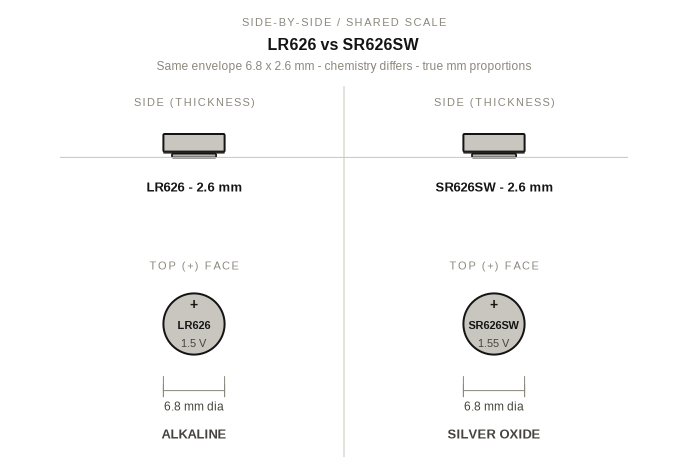
Short answer
If the movement or empty cell says 377 / SR626SW, buy silver oxide — not alkaline LR626 / AG4.
Trade numbers such as 377 → IEC codes (with alkaline twins listed separately) are on the watch battery chart under Tools.
Same size, different chemistry
Both are about 6.8 × 2.6 mm button cells. LR626 (also AG4 / LR66) is alkaline (~1.5 V) with a sloping discharge curve — common in low-cost gadgets and some fashion watches.
SR626SW is silver oxide (~1.55 V), often printed 377 / 377A on retail packs. Quartz watches that name 377 / SR626SW expect the flatter silver-oxide curve.
Pack labels that cause the mix-up
AG4 / LR66 usually mean alkaline LR626 — labelling, not a second size.
377 / 377A usually mean silver-oxide SR626SW. Charts that print “AG4 = 377 = LR626 = SR626SW” as one battery are wrong — we keep alkaline and silver oxide separate.
Examples on this site
SR626SW / 377: Casio MQ-24 (module 1330 family), Seiko Cal. 6G27, and Orient Cal. Y121 — confirm the module or calibre on the caseback.
LR626 / AG4: SYLVI Specter and Vogue (analog side) name alkaline LR626 — do not assume every “AG4 size” watch wants silver oxide.
If a manual says only “AG4” without chemistry, check whether the maker meant alkaline AG4 or used AG4 loosely for the silver-oxide size twin.
Do not confuse with SR621SW / 364
SR621SW (often sold as 364) shares the ~6.8 mm diameter but is shorter (~2.1 mm vs ~2.6 mm). It is not a drop-in for SR626SW / 377 — see LR621 vs SR621SW and the watch battery chart.
Do not use list
Do not treat 377 / SR626SW as an LR626 / AG4 equivalent (or the reverse) without checking the device.
Do not buy from a flattened “377 / AG4” blister without reading which chemistry the pack actually is.
Next steps on this site
Casio models: start at the Casio watch battery finder (module path) rather than guessing from the brand name alone.
If the watch has stopped and you are unsure it even needs a cell, see Why has my watch stopped? before buying.